A model that spots a mismatch is useful. A model that writes a confident explanation without checking the source can be dangerous in finance. Anthropic’s Claude Fable 5.2 announcement includes two concrete finance examples: a 10-K transferred into a forecasting template, and an inconsistency found in a loan application file.
Watch MosoFin’s Claude Fable 5.2 finance workflow video. It summarizes Anthropic’s reported examples; it is not a benchmark of MosoFin or a promise that every financial model will be correct.
Quick answer: Fable 5.2 may be worth testing on hard, document-heavy finance work. Anthropic’s examples show a model catching a source mismatch and handling an ambiguous forecast template. They are individual reported cases. Keep a human review that ties each number and assumption to the original record.
What the 10-K example shows
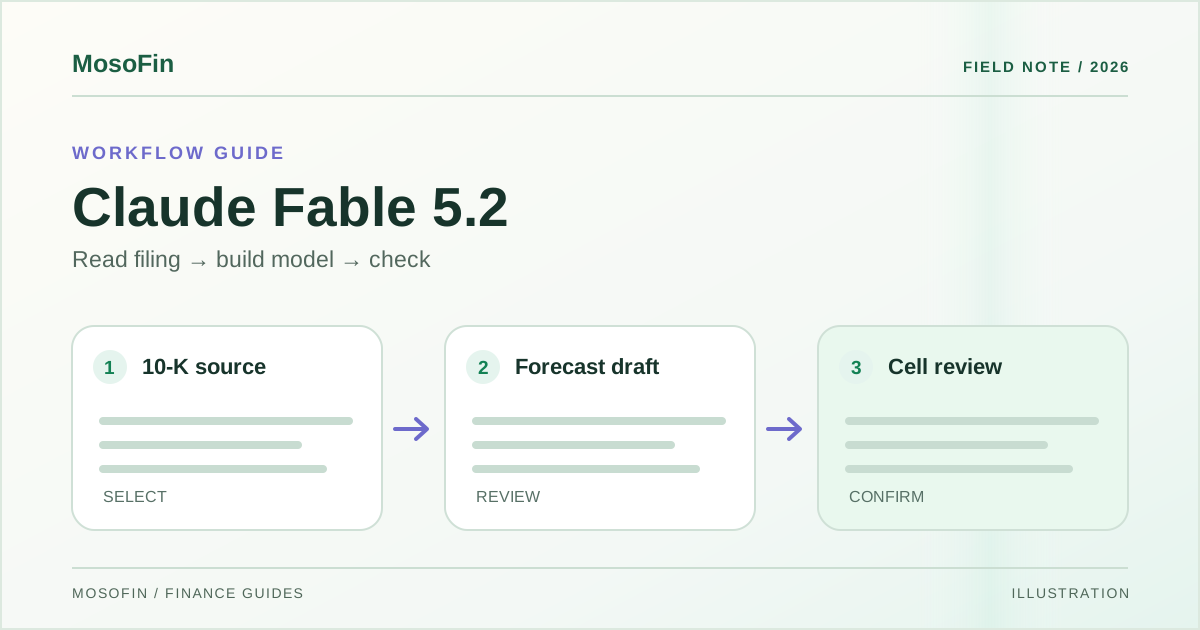
Fundamental Research Labs told Anthropic about a task that moved a company’s financial figures from its 10-K into a forecasting model. The template did not say whether one metric should use a reported figure or a calculation. According to the customer, Fable inferred the intended choice from formatting, noticed regional figures that did not sum to the reported total, and completed that test correctly.
The useful lesson is not “AI gets every cell right.” It is that a model can help surface an ambiguity before a forecast is accepted. In your own model, check:
- Which filing and reporting period supplied each input?
- Is the value a company-reported figure or a new calculation?
- Do regional or segment rows reconcile to the stated total?
- Are units, currencies, signs, and fiscal-year labels consistent?
- Which assumptions were inferred, and who approved them?
The customer’s result was one task in its own evaluation. It does not describe the error rate on your workbook.
What the loan-file example shows
Box reported that Fable flagged a mismatch between salary deposits and a bank statement balance in files attached to a loan application. That gave an underwriter a specific point to investigate. A mismatch is a review question, not proof that an applicant did anything wrong. The reviewer needs the statement dates, deposit details, other transfers, and the relevant policy before drawing a conclusion.
The same habit helps business finance reviews: turn a suspicious number into a source-backed question, then let an authorized person decide what it means.
Does a bigger model belong in every workflow?
Anthropic positions Fable and Mythos for ambitious technical work. Its announcement says most coding and knowledge tasks should start with Opus 5.5, then move to a more capable or smaller model as the job requires. It reports faster output and benchmark results, but a benchmark is not an audit of your books.
For a routine monthly variance review, the stronger process may be more valuable than the larger model: select the right workspace, define the period, retrieve source figures, check arithmetic, and record exceptions. Escalate to a more complex model only when the evidence or task needs it.
Where MosoFin fits
MosoFin’s job is to make authorized business data available for a read-only, source-linked review. It does not certify an AI forecast. A responsible question is: “For this workspace and period, show the transactions or reports behind the revenue figure, and mark anything missing.” Compare that output with the filing or workbook separately.
The video mentions several possible source connections. Check the current connections list before naming an integration in a live process. Do not combine sources or entities into a total unless the method and scope are clear. How MosoFin works explains the permission boundary.
A five-minute acceptance test
Give the model a small, known filing excerpt and a forecast template with one deliberately ambiguous metric. Ask it to identify the ambiguity, state its assumption, show source references, and reconcile the subtotal. Have a reviewer compare the result to the original excerpt and spreadsheet. Record every silent assumption and every missing citation. Expand only after that test is repeatable.
Frequently asked questions
Did Claude Fable 5.2 get every cell right in a financial model?
A named Anthropic customer reported that result on one 10-K-to-forecast task. It is not a guarantee for other filings, templates, or models.
Should a finance team switch every task to Fable 5.2?
No. Anthropic recommends starting with Claude Opus 5.5 for most coding and knowledge tasks and moving to Fable for more ambitious work when needed.
Can MosoFin verify an AI-generated forecast?
MosoFin can support source-linked, read-only review of authorized data. A human still needs to check model formulas, assumptions, periods, and any external filing before using a forecast.
Sources
- Anthropic — Claude Fable 5.2 and Mythos 5.2, November 9, 2026; includes the named Fundamental Research Labs and Box examples.
- MosoFin — Claude Just Dropped Fable 5.2: What It Changes in Your Finance Workflow, our explainer.
Related: How to read a profit and loss statement · MosoFin workflows