An AI assistant can write a clear answer to “Why did profit fall last month?” in seconds. The answer can still use the wrong company, period, or definition. A polished sentence is not evidence that the underlying number is right.
Quick answer: Before sharing an AI finance answer, check the workspace and company, the source records, the dates and accounting basis, the calculation, and the person who approves the conclusion.
The U.S. National Institute of Standards and Technology’s generative AI risk profile describes human review, tracking, and documentation as ways organizations can manage generative AI risk. The checks below apply that principle to a small-business finance question. They are a review workflow, not a guarantee of accuracy.
A five-check review
| Check | Ask this before sharing | Evidence to keep |
|---|---|---|
| 1. Scope | Which workspace, legal entity, and connected account supplied the data? | Workspace and company name |
| 2. Source | Can you open the transaction or report behind each important figure? | Source system, report name, record ID, and retrieval date |
| 3. Period | Are the date range, cash or accrual basis, currency, and comparison period the same? | Report settings and time zone where relevant |
| 4. Math and meaning | Do the totals add up, and is the explanation supported by the records? | A short calculation and unresolved exceptions |
| 5. Approval | Who can decide that the accounting treatment and final wording are suitable? | Reviewer, decision, and date |
Worked example: “Why did profit fall?”
Illustrative figures, not a customer result: An assistant says that October profit fell by $8,000 because software costs rose. The October P&L shows software expense of $6,000, up from $2,000 in September. That explains $4,000 of the expense change, but it does not by itself explain the full $8,000 profit change. Revenue and other expenses might have moved too.
Ask the assistant to show both P&L reports with the same accounting basis and the line items used in its explanation. Then compare the remaining $4,000 difference. If the two reports use different settings, correct the comparison before drawing a conclusion. Intuit’s US custom-report guide shows how report periods and filters can change what a QuickBooks report displays.
This example is why a citation alone is insufficient. A real record can support one number while the sentence connecting that number to a conclusion remains incomplete.
MosoFin provides read-only review. See the 14-day trial terms, including the $0.99 activation fee and the selected plan charge on day 15 unless you cancel.
Where MosoFin fits
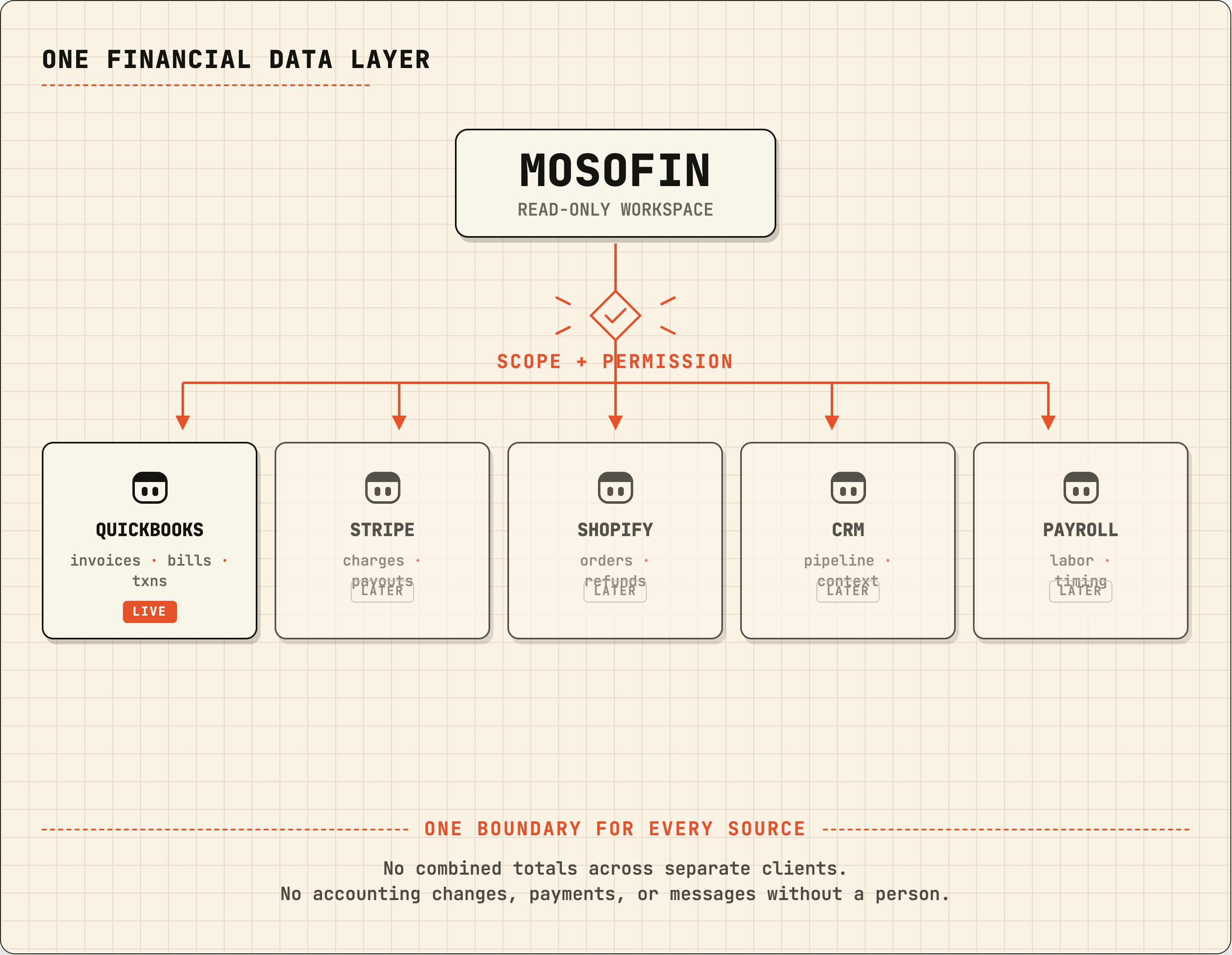
MosoFin lets a permitted user ask questions about connected business data in a supported AI app. For a QuickBooks review, ask for the company, report period, basis, source figures, and exceptions in the answer. MosoFin’s access is read-only; it does not close the books or approve accounting judgments. Available records and tools depend on the connection, account permissions, plan, and workspace.
Try this prompt: “For the selected QuickBooks company, compare October and September P&L results on the same basis. Show the source report settings, the largest line-item changes, the arithmetic behind the profit change, and anything you cannot explain. Do not post or change transactions.” A person should open the referenced reports and approve any external summary.
For more on approval limits, read approval boundaries for AI finance bots. If the answer spans companies, see multi-entity reporting versus selected-workspace analysis.
Frequently asked questions
Is an AI answer enough for a lender or board report?
No. Check the source records, calculation, scope, and accounting treatment. Have the responsible person approve the final report.
Does a source link prove that an AI answer is correct?
No. A source link helps a reviewer find the record, but the reviewer must still check the period, completeness, interpretation, and arithmetic.
Can MosoFin change my QuickBooks books?
No. MosoFin’s QuickBooks review tools are read-only and cannot post or reconcile transactions.